
Key parameters at a glance
- A radius of 3.69 Earth radii
- A mass of 13.15 Earth masses
- Surface gravity around 0.97 g
- An orbital period of 3.718 days
- Semi-major axis 0.0226 AU
- Distance from Earth 51.40 light-years
- Earth Similarity Index 0.570
- Travel time at Voyager 1 speed 906,512 years
- Almost certainly tidally locked to its host star given the close orbit
Context from the literature
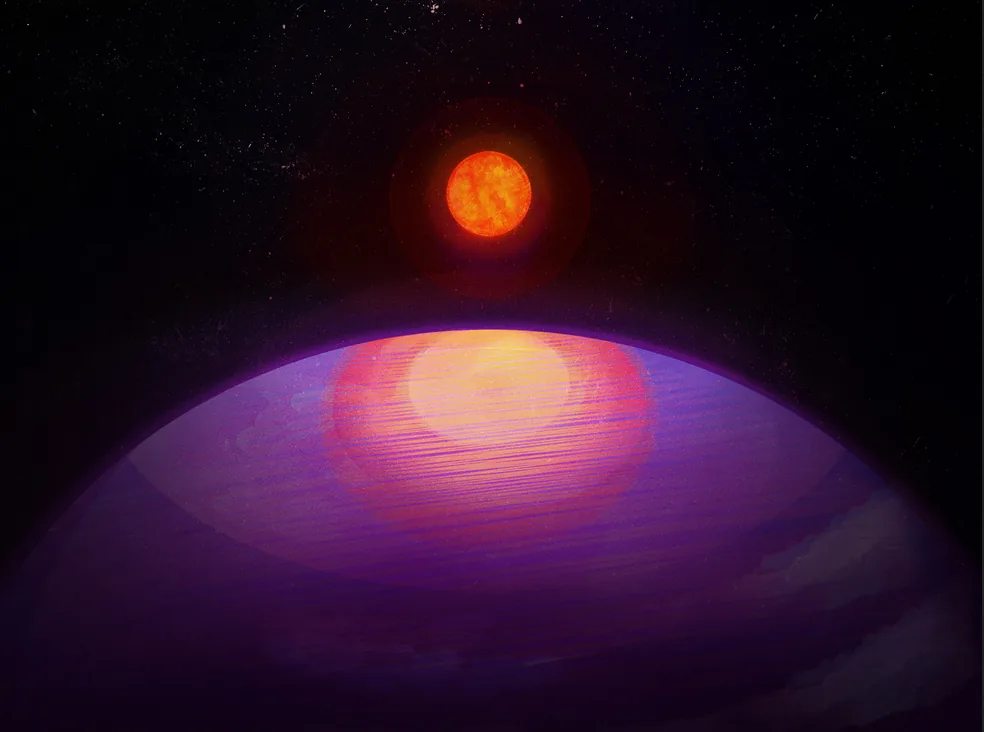
LHS 3154 b is a Neptune-sized exoplanet orbiting the red dwarf LHS 3154. It is located about 50 light-years from Earth, in the constellation of Hercules. As it is a massive planet that orbits very close to a low-mass star, it is challenging current models about exoplanet formation, as it would require 10 times more mass than there was in the protoplanetary disk where the planet formed.
Excerpted from Wikipedia · full article
LHS 3154 b Planet Profile
Physical Specs
Classification
Planet Type
Sub-Neptune
Discovery
Size rank in cohort
Rank by radius
#92of 1978
top 4.6%
This planet
3.69R⊕
Sub-Neptune median
2.71R⊕
Nearest-size peers
| Metric | Earth | LHS 3154 b | Jupiter |
|---|---|---|---|
| Radius (R⊕) | 1.00 | 3.69 | 11.21 |
| Mass (M⊕) | 1.00 | 13.15 | 317.83 |
| Density (g/cm³) | 5.51 | 1.44 | 1.33 |
| Surface Gravity (g) | 1.00 | 0.97 | 2.53 |
| Insolation (S⊕) | 1.00 | — | 0.037 |
Alternative Mass Estimates
| Method | Value | Interpretation |
|---|---|---|
| Minimum mass (M sin i) | 13.150 M⊕ | Lower bound from radial-velocity fitting. |
Star Catalogue Identifiers
TIC
TIC 24108819
Gaia DR2
Gaia DR2 1380293091823646720
Gaia DR3
Gaia DR3 1380293091823646720
System
LHS 3154
Percentile among Sub-Neptune cohort
Orbit & Habitability
Orbital Dynamics
Year Length
A year here lasts approximately 3.72 Earth days (1.0% of a terrestrial year) on a nearly circular orbit at a mean orbital distance of 0.0226 AU.
Extended Orbital Architecture
RV semi-amplitude (K)
23.400 m/s
Transit mid-time (BJD)
2,458,874.0000
Long. of periastron (ω)
82.00°
Angular separation (arcsec)
1.44000
Eq. Temperature
—
Insolation (S⊕)
—
Earth = 1.00
Earth Similarity (ESI)
0.570
0 = alien, 1 = Earth-identical
Insufficient insolation data. Close-orbiting tidally-locked around a cool host.
Discovery Paper
Primary reference
Stef Aacute Nsson et al. 2023Instrument
Habitable Zone Planet Finder (HPF) spectrograph
Publication
2023-12
Observation locale
Ground
Discovery cohort
Planets confirmed in 2023 at McDonald Observatory (2 shown).
Host System: LHS 3154
Spectral Class
M-type red dwarf
Effective Temperature
2,861 K — cooler than the Sun (5,778 K)
Estimated Age
5.00 Gyr — older than the Sun (4.6 Gyr)
Stellar Radius
0.141 R☉
Stellar Mass
0.112 M☉
Metallicity [Fe/H]
—
Extended Stellar Properties
Surface gravity (log g)
5.200 dex
Stellar density
58.146 g/cm³
Systemic radial velocity
-42.05 km/s
Rotational v·sin i
2.00 km/s
Rotation period
114.00 days
Multi-band Host Photometry — 6 bands
Astrometric Data
Parallax
63.421 mas
Total Proper Motion
734.519 mas/yr
PM Right Ascension
-716.22 mas/yr
PM Declination
162.94 mas/yr
Galactic Cartesian (pc)
x = -0.359 · y = -0.665 · z = 0.655
Equatorial (J2000)
RA 241.63673° · Dec 40.90682°
Galactic ℓ, b
64.967° · 47.889°
Ecliptic λ, β
224.241° · 59.921°
HTM-20 index
-165666931
Similar Worlds
LSPM J2116+0234 b
Sub-Neptune · M-type red dwarf
Radius 3.71 R⊕ · 57.5 ly
Gl 378 b
Sub-Neptune · M-type red dwarf
Radius 3.66 R⊕ · 48.8 ly
GJ 27.1 b
Sub-Neptune · M-type red dwarf
Radius 3.66 R⊕ · 77.0 ly
TOI-1231 b
Sub-Neptune · M-type red dwarf
Radius 3.65 R⊕ · 90.1 ly
HIP 107772 b
Sub-Neptune · M-type red dwarf
Radius 3.64 R⊕ · 77.1 ly
Kepler-210 c
Sub-Neptune · M-type red dwarf
Radius 3.62 R⊕ · 759.1 ly