Key parameters at a glance
- A radius of 2.83 Earth radii
- A mass of 8.40 Earth masses
- Surface gravity around 1.05 g
- An orbital period of 2.646 days
- Semi-major axis 0.0287 AU
- Distance from Earth 66.46 light-years
- Earth Similarity Index 0.660
- Travel time at Voyager 1 speed 1,172,088 years
- Almost certainly tidally locked to its host star given the close orbit
Context from the literature
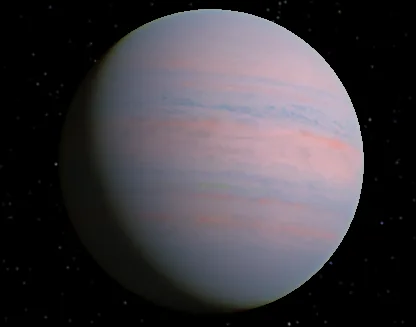
GJ 3634 b is a super-Earth exoplanet in the orbit of the nearby red dwarf GJ 3634 at approximately 64.5 light-years in constellation Hydra. The planet is approximately eight times the mass of Earth, and orbits its star every two and a half days at a distance of 0.0287 AU. The planet was the first to be discovered by a group of astronomers searching for exoplanets in the orbit of very-low-mass stars after the team reorganized their strategy, choosing to search for targets that they could also confirm using the transit method. However, a transit event associated with GJ 3634 b was not detected. The planet's discovery was published in Astronomy and Astrophysics on February 8, 2011.
Excerpted from Wikipedia · full article
GJ 3634 b Planet Profile
Physical Specs
Classification
Planet Type
Sub-Neptune
Discovery
Size rank in cohort
Rank by radius
#703of 1978
top 35.5%
This planet
2.83R⊕
Sub-Neptune median
2.71R⊕
Nearest-size peers
| Metric | Earth | GJ 3634 b | Jupiter |
|---|---|---|---|
| Radius (R⊕) | 1.00 | 2.83 | 11.21 |
| Mass (M⊕) | 1.00 | 8.40 | 317.83 |
| Density (g/cm³) | 5.51 | 2.04 | 1.33 |
| Surface Gravity (g) | 1.00 | 1.05 | 2.53 |
| Insolation (S⊕) | 1.00 | — | 0.037 |
Alternative Mass Estimates
| Method | Value | Interpretation |
|---|---|---|
| Best measured mass | 8.400 M⊕ | Direct mass measurement (not derived). |
| Minimum mass (M sin i) | 7.000 M⊕ | Lower bound from radial-velocity fitting. |
| Computed mass | 8.200 M⊕ | Model-computed mass (e.g. from mass-radius relation). |
Star Catalogue Identifiers
TIC
TIC 49064384
Gaia DR2
Gaia DR2 5452743423618768000
Gaia DR3
Gaia DR3 5452743423618768000
System
GJ 3634
Percentile among Sub-Neptune cohort
Orbit & Habitability
Orbital Dynamics
Year Length
A year here lasts approximately 2.65 Earth days (0.7% of a terrestrial year) on a nearly circular orbit at a mean orbital distance of 0.0287 AU.
Eq. Temperature
—
Insolation (S⊕)
—
Earth = 1.00
Earth Similarity (ESI)
0.660
0 = alien, 1 = Earth-identical
Insufficient insolation data. Close-orbiting tidally-locked around a cool host.
Discovery Paper
Primary reference
Bonfils et al. 2011Instrument
HARPS Spectrograph
Publication
2011-04
Observation locale
Ground
Discovery cohort
Planets confirmed in 2010 at La Silla Observatory (12 shown).
Host System: GJ 3634
Spectral Class
M-type red dwarf
Effective Temperature
3,517 K — cooler than the Sun (5,778 K)
Estimated Age
5.00 Gyr — older than the Sun (4.6 Gyr)
Stellar Radius
0.430 R☉
Stellar Mass
0.450 M☉
Metallicity [Fe/H]
—
Extended Stellar Properties
Surface gravity (log g)
4.776 dex
Stellar density
6.740 g/cm³
Systemic radial velocity
5.19 km/s
Rotational v·sin i
1.00 km/s
Multi-band Host Photometry — 11 bands
Astrometric Data
Parallax
49.044 mas
Total Proper Motion
574.178 mas/yr
PM Right Ascension
-566.86 mas/yr
PM Declination
-91.37 mas/yr
Galactic Cartesian (pc)
x = -0.825 · y = 0.227 · z = -0.517
Equatorial (J2000)
RA 164.64335° · Dec -31.14434°
Galactic ℓ, b
276.221° · 25.809°
Ecliptic λ, β
179.842° · -34.380°
HTM-20 index
1794520735
Similar Worlds
TOI-5319 b
Sub-Neptune · M-type red dwarf
Radius 2.83 R⊕ · 199.5 ly
HD 285968 b
Sub-Neptune · M-type red dwarf
Radius 2.83 R⊕ · 30.9 ly
Kepler-83 b
Sub-Neptune · M-type red dwarf
Radius 2.83 R⊕ · 1,306.0 ly
GJ 4274 c
Sub-Neptune · M-type red dwarf
Radius 2.83 R⊕ · 23.6 ly
TOI-4479 b
Sub-Neptune · M-type red dwarf
Radius 2.82 R⊕ · 263.1 ly
TOI-756 b
Sub-Neptune · M-type red dwarf
Radius 2.81 R⊕ · 281.1 ly