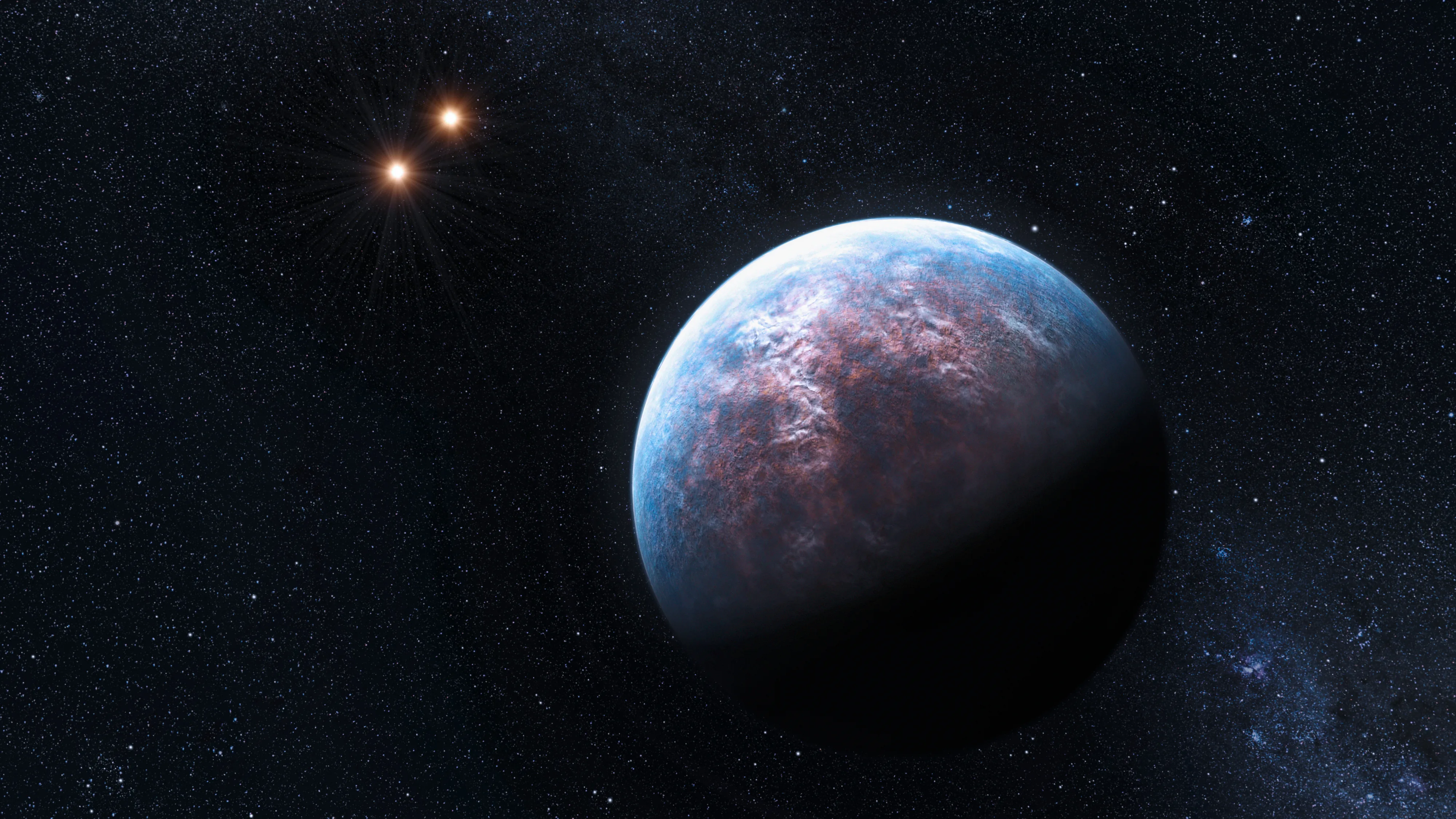
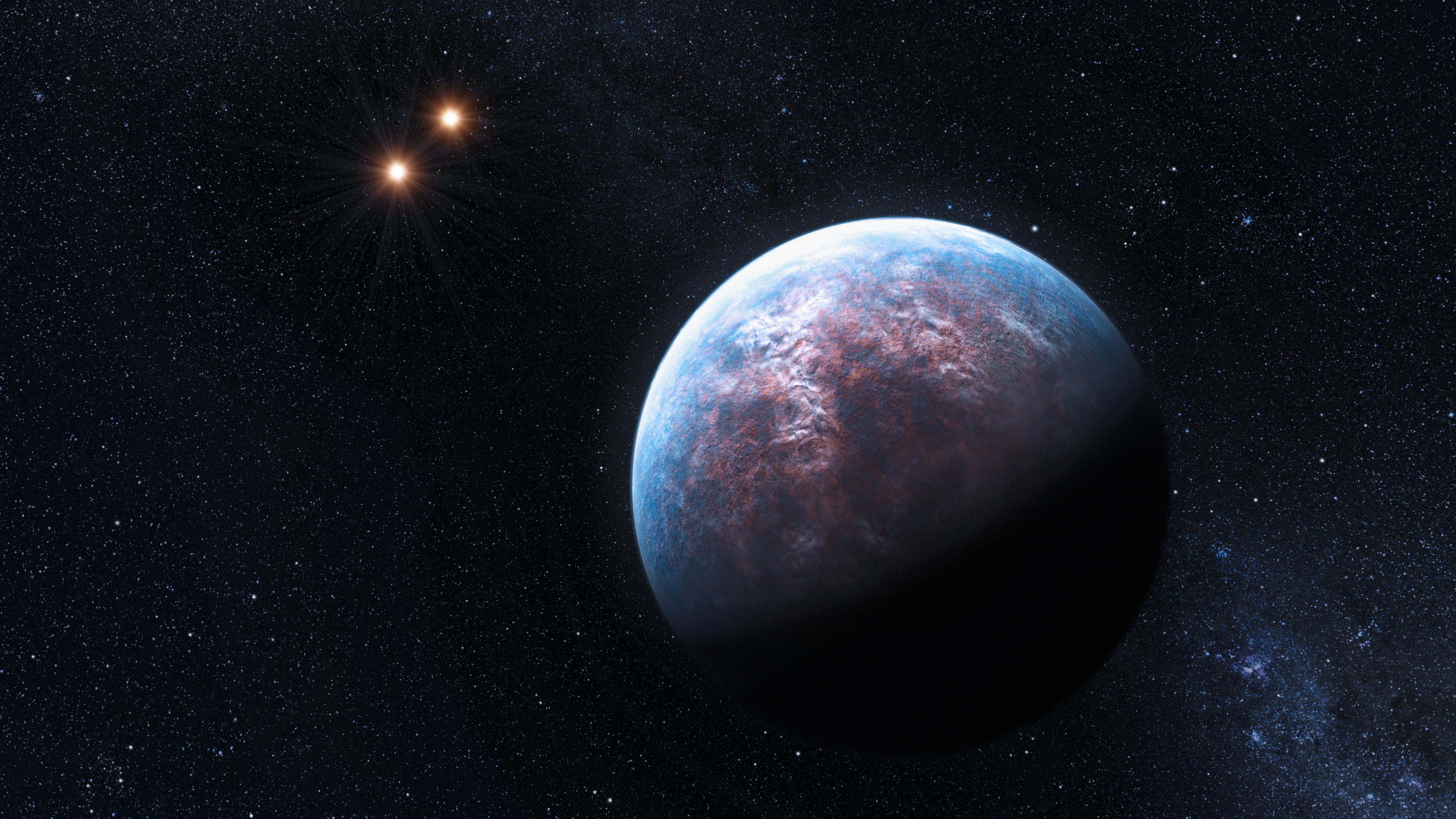
Key parameters at a glance
- A radius of 2.25 Earth radii
- A mass of 5.68 Earth masses
- Surface gravity around 1.12 g
- An orbital period of 7.203 days
- Semi-major axis 0.0504 AU
- Distance from Earth 23.63 light-years
- Earth Similarity Index 0.742
- Travel time at Voyager 1 speed 416,655 years
- Almost certainly tidally locked to its host star given the close orbit
Context from the literature
Gliese 667 Cb is an exoplanet orbiting the star Gliese 667 C, a member of the Gliese 667 triple-star system. It is the most massive planet discovered in the system and is likely a super-Earth or a mini-Neptune. Orbital-stability analysis indicates that it cannot be more than twice its minimum mass. It orbits too close to the star to be in the habitable zone and thus not suitable for life as we know it. Eccentricity analysis indicates that Gliese 667 Cb is not a rocky planet.
Excerpted from Wikipedia · full article
1 sibling around GJ 667 C
GJ 667 C b shares its host star with 1 other confirmed planet. Side-by-side measurements below.
| Planet | Type | Radius (R⊕) | Mass (M⊕) | Period (d) | Eq. T (K) | Year |
|---|---|---|---|---|---|---|
| GJ 667 C b this | Sub-Neptune | 2.25 | 5.68 | 7.203 | — | 2012 |
| GJ 667 C c | Super-Earth | 1.77 | 3.80 | 28.140 | — | 2013 |
GJ 667 C b Planet Profile
Physical Specs
Classification
Planet Type
Sub-Neptune
Discovery
Size rank in cohort
Rank by radius
#1589of 1978
top 80.3%
This planet
2.25R⊕
Sub-Neptune median
2.71R⊕
Nearest-size peers
| Metric | Earth | GJ 667 C b | Jupiter |
|---|---|---|---|
| Radius (R⊕) | 1.00 | 2.25 | 11.21 |
| Mass (M⊕) | 1.00 | 5.68 | 317.83 |
| Density (g/cm³) | 5.51 | 2.74 | 1.33 |
| Surface Gravity (g) | 1.00 | 1.12 | 2.53 |
| Insolation (S⊕) | 1.00 | — | 0.037 |
Alternative Mass Estimates
| Method | Value | Interpretation |
|---|---|---|
| Minimum mass (M sin i) | 5.680 M⊕ | Lower bound from radial-velocity fitting. |
Star Catalogue Identifiers
TIC
TIC 154385809
Gaia DR2
Gaia DR2 5975663354131618304
Gaia DR3
Gaia DR3 5975663354131618304
System
GJ 667
Percentile among Sub-Neptune cohort
Orbit & Habitability
Orbital Dynamics
Year Length
A year here lasts approximately 7.20 Earth days (2.0% of a terrestrial year) on a mildly elliptical path at a mean orbital distance of 0.0504 AU.
Eq. Temperature
—
Insolation (S⊕)
—
Earth = 1.00
Earth Similarity (ESI)
0.742
0 = alien, 1 = Earth-identical
Insufficient insolation data. Close-orbiting tidally-locked around a cool host.
Discovery Paper
Primary reference
Bonfils et al. 2013Instrument
HARPS Spectrograph
Publication
2013-01
Observation locale
Ground
Discovery cohort
Planets confirmed in 2012 at La Silla Observatory (11 shown).
Host System: GJ 667 C
Spectral Class
M-type red dwarf
Effective Temperature
3,350 K — cooler than the Sun (5,778 K)
Estimated Age
2.00 Gyr — younger than the Sun (4.6 Gyr)
Stellar Radius
—
Stellar Mass
0.330 M☉
Metallicity [Fe/H]
-0.55
Extended Stellar Properties
Surface gravity (log g)
4.690 dex
Systemic radial velocity
6.50 km/s
Metallicity ratio
[Fe/H]
Multi-band Host Photometry — 10 bands
Astrometric Data
Parallax
138.017 mas
Total Proper Motion
1,151.955 mas/yr
PM Right Ascension
1,131.61 mas/yr
PM Declination
-215.55 mas/yr
Galactic Cartesian (pc)
x = -0.146 · y = -0.806 · z = -0.574
Equatorial (J2000)
RA 259.75106° · Dec -34.99777°
Galactic ℓ, b
351.842° · 1.410°
Ecliptic λ, β
261.431° · -11.863°
HTM-20 index
-1660932496
Similar Worlds
K2-9 b
Sub-Neptune · M-type red dwarf
Radius 2.25 R⊕ · 270.6 ly
Kepler-155 c
Sub-Neptune · M-type red dwarf
Radius 2.24 R⊕ · 957.3 ly
TOI-663 c
Sub-Neptune · M-type red dwarf
Radius 2.26 R⊕ · 209.5 ly
Gl 49 b
Sub-Neptune · M-type red dwarf
Radius 2.24 R⊕ · 32.1 ly
GJ 3929 c
Sub-Neptune · M-type red dwarf
Radius 2.26 R⊕ · 51.6 ly
K2-264 b
Sub-Neptune · M-type red dwarf
Radius 2.23 R⊕ · 605.4 ly